
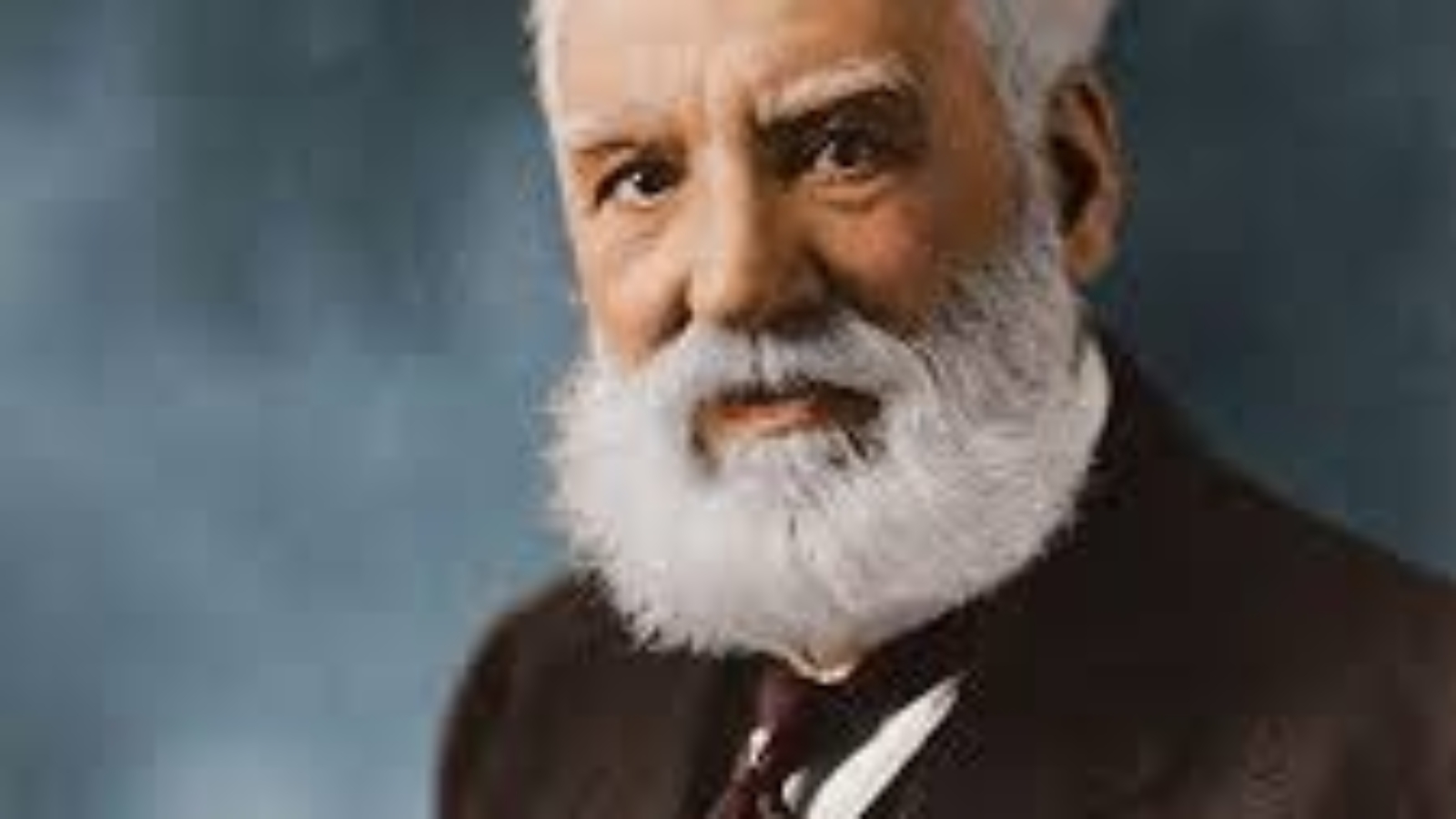
The waves crashed softly against the coast of Nova Scotia as a young boy listened, not to the sea, but to silence. His mother was slowly going deaf, and Bell, barely a child, leaned in close to speak through touch and tone.
That moment shaped a life.
He would spend the rest of his years chasing sound, not just to hear it better, but to send it across distance, wire, and time.
This is Alexander Graham Bell, and this story isn’t just about his invention of the telephone. It’s about a man who bridged silence and speech, isolation and connection. A real-life hero of communication.
Who Was Alexander Graham Bell?
Who was Alexander Graham Bell? Born in Edinburgh, Scotland, in 1847, Bell was raised in a family where sound was studied like poetry.
His father developed visible speech systems; his mother, though deaf, encouraged music and curiosity. From the start, Bell’s work with the deaf was not a side project. It was the heartbeat of his life.
When the family moved to Canada, and later when Bell settled in the United States, he carried that mission with him, teaching, experimenting, and always asking, “Can we make sound visible?” Can we make it travel?
He wasn’t chasing fame. He was looking to understand the world around him and, more importantly, understand sound itself.
The Invention That Rang Through Time
In 1876, his questions found an answer.
Bell picked up his prototype—wires, diaphragms, magnets—and sent the first spoken message to his assistant: “Mr. Watson, come here. I want to see you.” A sentence that would change the shape of human interaction forever.
That was the birth of the telephone, the greatest of Alexander Graham Bell’s inventions, though far from the last; Bell worked on sound transmitters, photophones (an early version of wireless communication), and even advanced techniques for teaching speech to the deaf.
The history of the telephone and Bell’s contributions is not just a chapter in science books. It’s a foundation of modern life, because Bell didn’t just invent a machine. He reshaped how humans connect.
A Mind That Never Stopped Inventing
It would be easy to stop the story there, but Bell didn’t. Bell simply never stopped.
He went on to co-found the journal Science, helped improve hydrofoils and metal detectors, and even experimented with aviation.
His name appears across countless patents. Yet he always circled back to what mattered most: the people. He created not just to create, but for the people. To help them connect in ways no one thought possible before.
Alexander Graham Bell’s most important inventions weren’t just mechanical; they were useful and meaningful. Among the many brilliant inventors of the 19th century, Bell stood out for the heart behind his inventions.
The Echoes of Connection
Today, when a voice crosses the globe in seconds or a video call brings distant families face-to-face, you may not think of Alexander Graham Bell, but his legacy is right there, woven into how we live and love.
The history of communication technology is long and complex, but Bell’s chapter is among the most transformative because this man dreamed in questions, worked in wires, and believed sound could do more than carry words; it could carry empathy.
At Global Edutopia, we remember Alexander Graham Bell not just as an inventor, but as a listener, as someone who tuned in to silence and heard possibility.
Want to Know More?
Every ring of a phone, every ping of a message, and every whispered hello across oceans cascades from Bell’s dream.
This biography of Alexander Graham Bell is part of a larger collection of works by people who didn’t just invent things but also changed the way people communicate with each other.
Want to learn about more heroes who brought people together and came up with new ways to connect? Look through our collection of real-life heroes to find the people who made the world a little louder and a little easier to hear.